Daily Dungeon Level
A dungeon crawl for one, on one side of paper
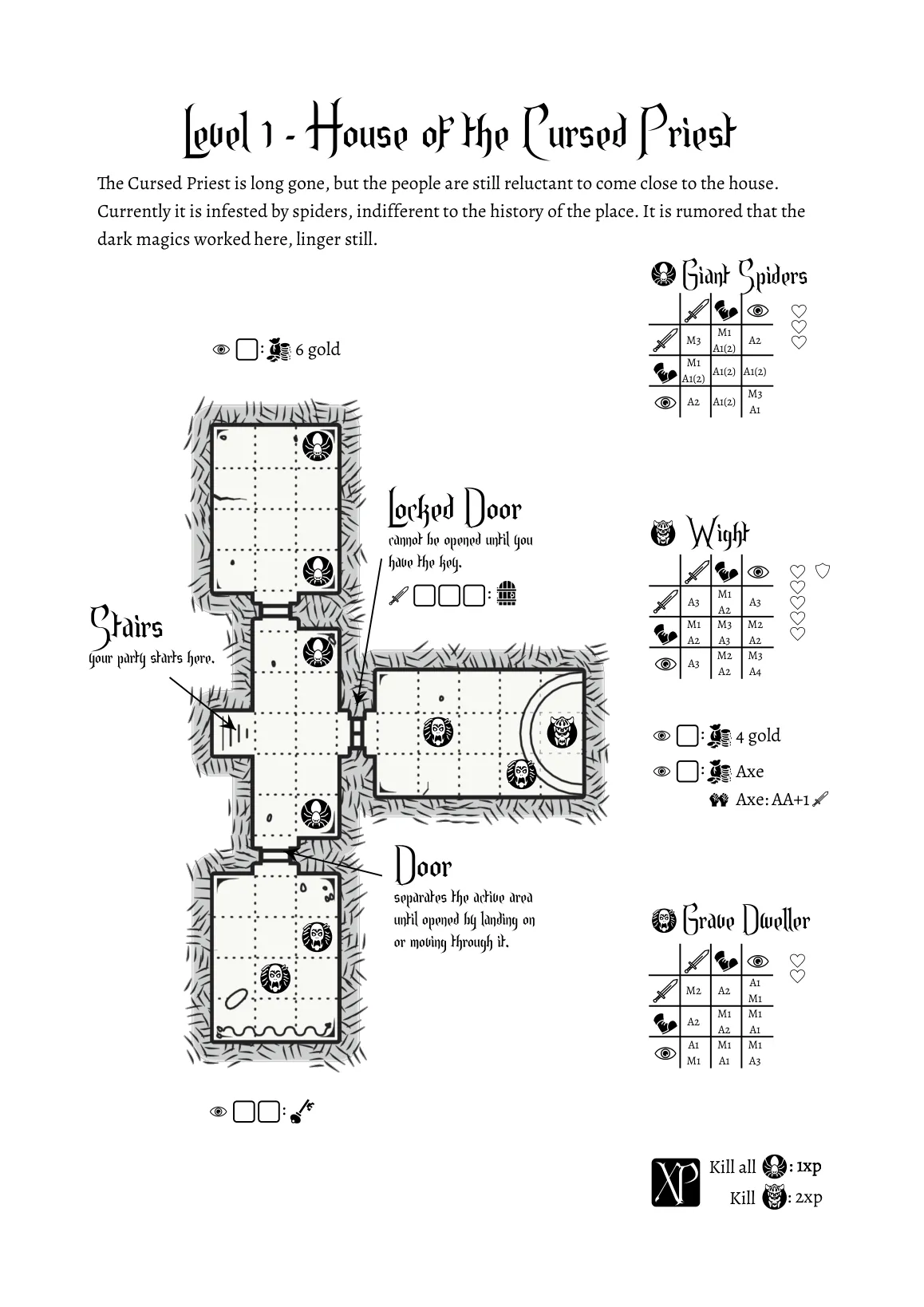
Daily Dungeon Level was an attempt to make the thing Wordle is, for the game I actually like: a small, complete, self-contained puzzle that arrives once a day, costs you fifteen minutes, and is the same for everybody who plays it. Except instead of five letters, a dungeon.
The format was fixed before anything else. One sheet of A4. The level on one side, everything you need to read it on the other. You print it, you play it with a pen, and the sheet is the save file. No dice, no app, no setup, nothing to punch out.
It got as far as three levels, a village, a rules sheet and two premade characters, in May and June of 2020. Then it stopped — not because it wasn’t fun, but because of something I only understood by building it. That part is its own post.
No dice, and no dungeon master
The problem with solo dungeon crawls is usually the same one: something has to decide what the monsters do, and if it isn’t a person it’s a dice table you roll on for every monster, every turn. That is a lot of admin for a fifteen minute puzzle, and it makes the game a slot machine rather than a thing you can plan against.
So the monsters here are deterministic, and what determines them is you.
Every character action is one of three kinds — a boot, a sword, or an eye. Each monster type on a level carries a three-by-three grid. You choose an action for each of your two characters, you carry them out, and then you cross-reference the two action kinds on the grid to find out what every monster of that type does in response. Move 2 and attack. Attack all adjacent for 2. Move 1 and shoot at range.
Nothing is hidden and nothing is random, which means the whole level is solvable in advance if you are willing to sit and look at it. Choosing to sneak past with two eye actions is choosing what the wight does about it. That is the game: not “what will happen”, but “what am I telling the room to do”.
Plays, and a sheet that gets smaller
The campaign layer is the part I am still fond of.
A character has eight actions and six columns of checkboxes labelled play 1 to play 6. Within a play you cannot use the same action twice, so a play is a hand of eight cards you spend down. To start a new play you have to retire one action permanently — check its remaining boxes and pick up something new.
Then the same checkboxes do all the other work. Take a hit you can’t afford and you may accept a wound instead: check a box, and that action is gone from that play for the rest of the character’s life. Get dropped to zero life and you retreat from the level with a wound. Spend experience to raise a number in an action, and you check a box for that too — with experience comes age.
So there is exactly one mechanism, a checkbox, and it means growth, injury and ageing at once. A character improves and narrows at the same time, on one sheet of paper, and eventually you retire them and start someone new. I don’t think I’d change any of that.
Between levels
Not everything is a dungeon. Some days you come out into a village and get to spend the gold, which existed mostly to give the daily rhythm a shape — a run of levels, then a breather, then a run of levels.
Villages have finite stock. There are two shortswords in Warrin’s Bark and when they’re gone they’re gone, which is crossed off on the sheet and stays crossed off. You can only come back if a level tells you that you can.
Where the art came from
The floorplans started as output from Watabou’s One Page Dungeon generator and were then edited by hand — rooms reshaped, monsters and treasure placed, doors and secret doors decided, the grid made to mean something. The villages come from the same author’s Village Generator. Twelve were generated, named and put aside; one of them got a shop.
Both are excellent, and both were doing a job I could not have done myself in the time — the sheets look hand-drawn because the generators draw that way, and that look is most of why the format felt worth pursuing at all.
Where it stopped
Three levels in, the sheets were getting busier rather than tighter. Each one needed more marginal notes than the last, and the thing I was really designing was not a daily puzzle but a boardgame that happened to be printed one page at a time.
The reason for that turned out to be interesting enough that I wrote it up separately: what Wordle is actually leaning on.
Look at it
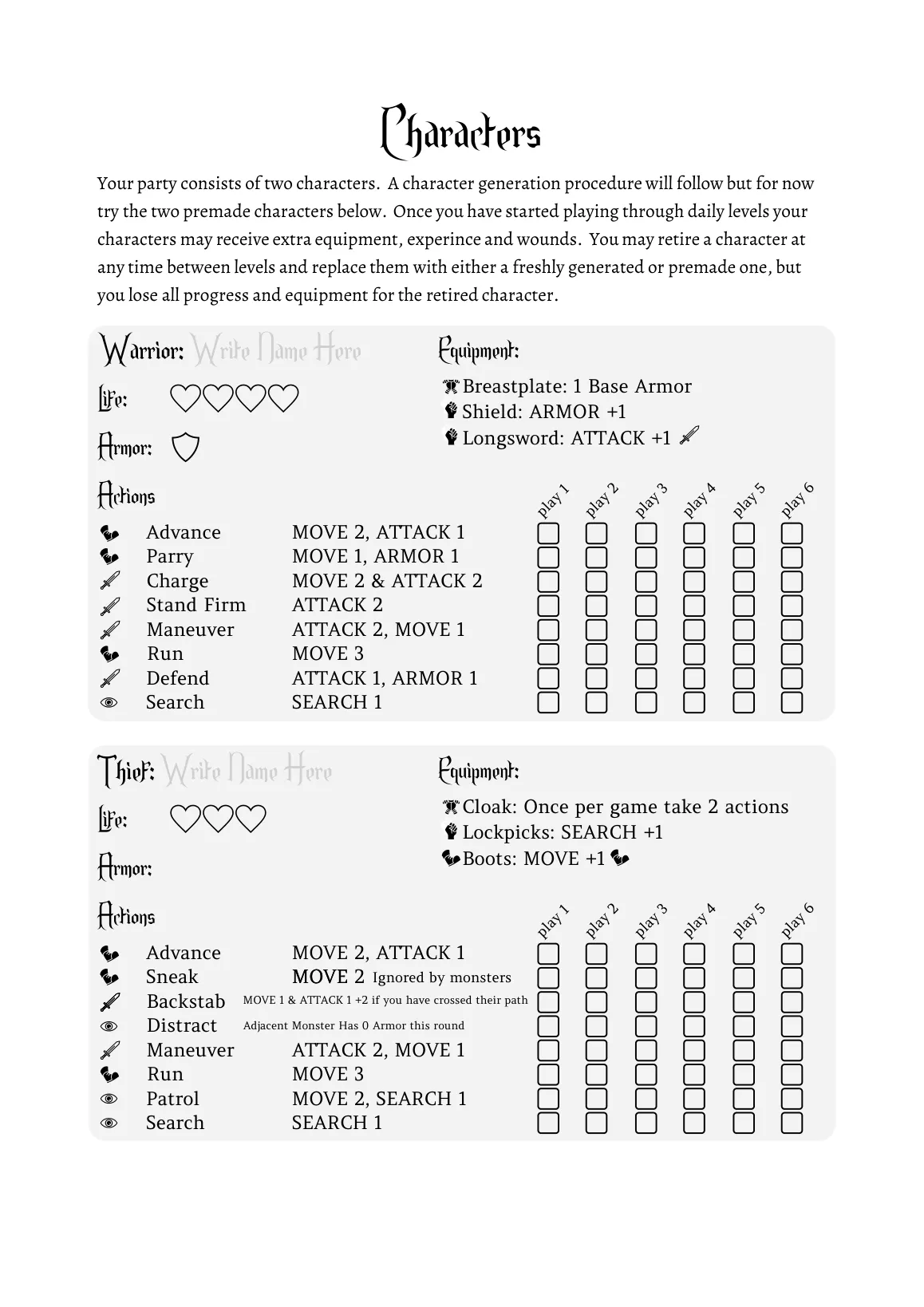
The whole campaign lives on this page. Every box you check is permanent — spend experience, take a wound, and the sheet gets smaller. 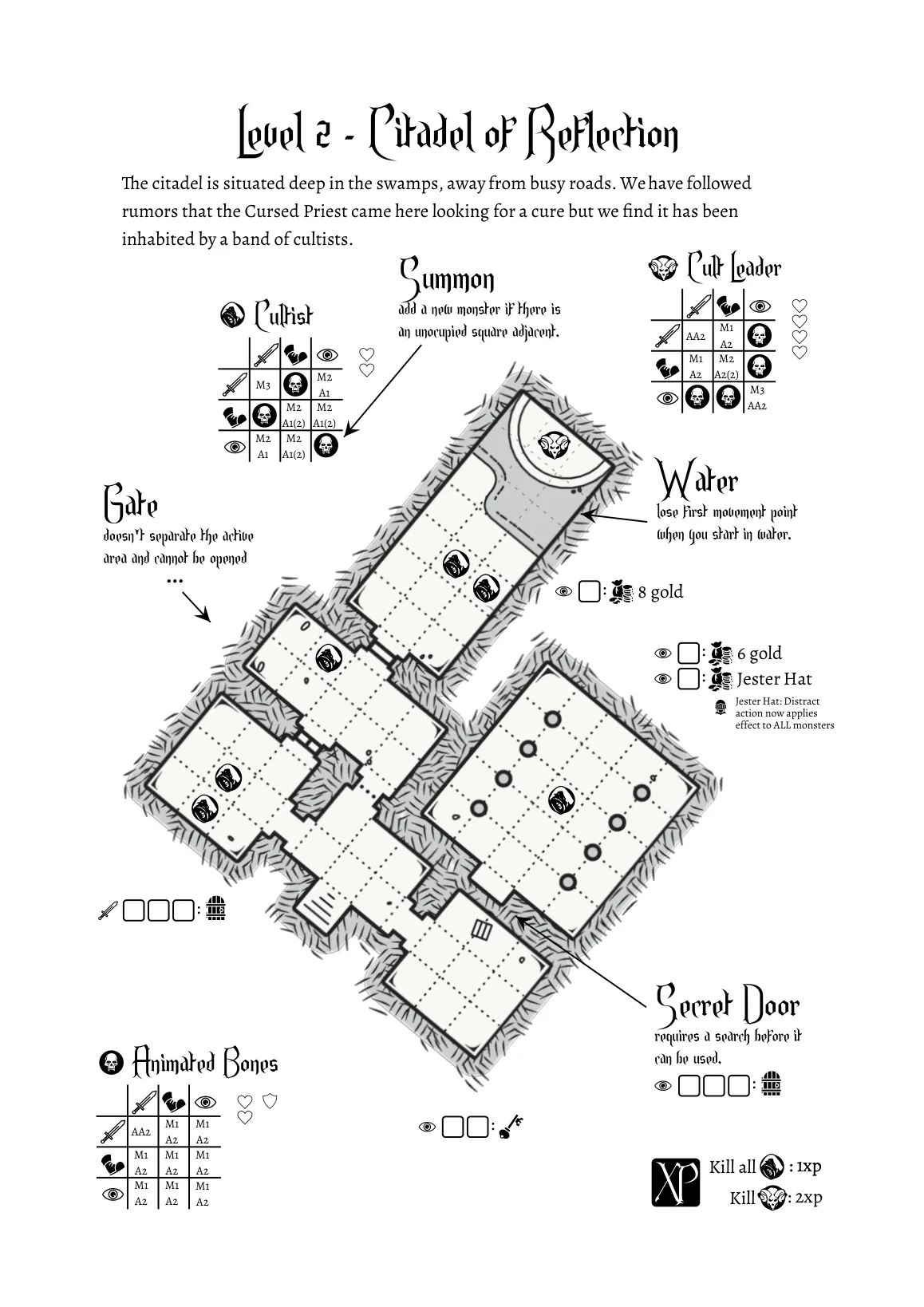
Level 2. The marginal notes are the tell — every sheet had to re-teach whatever was unusual about it. 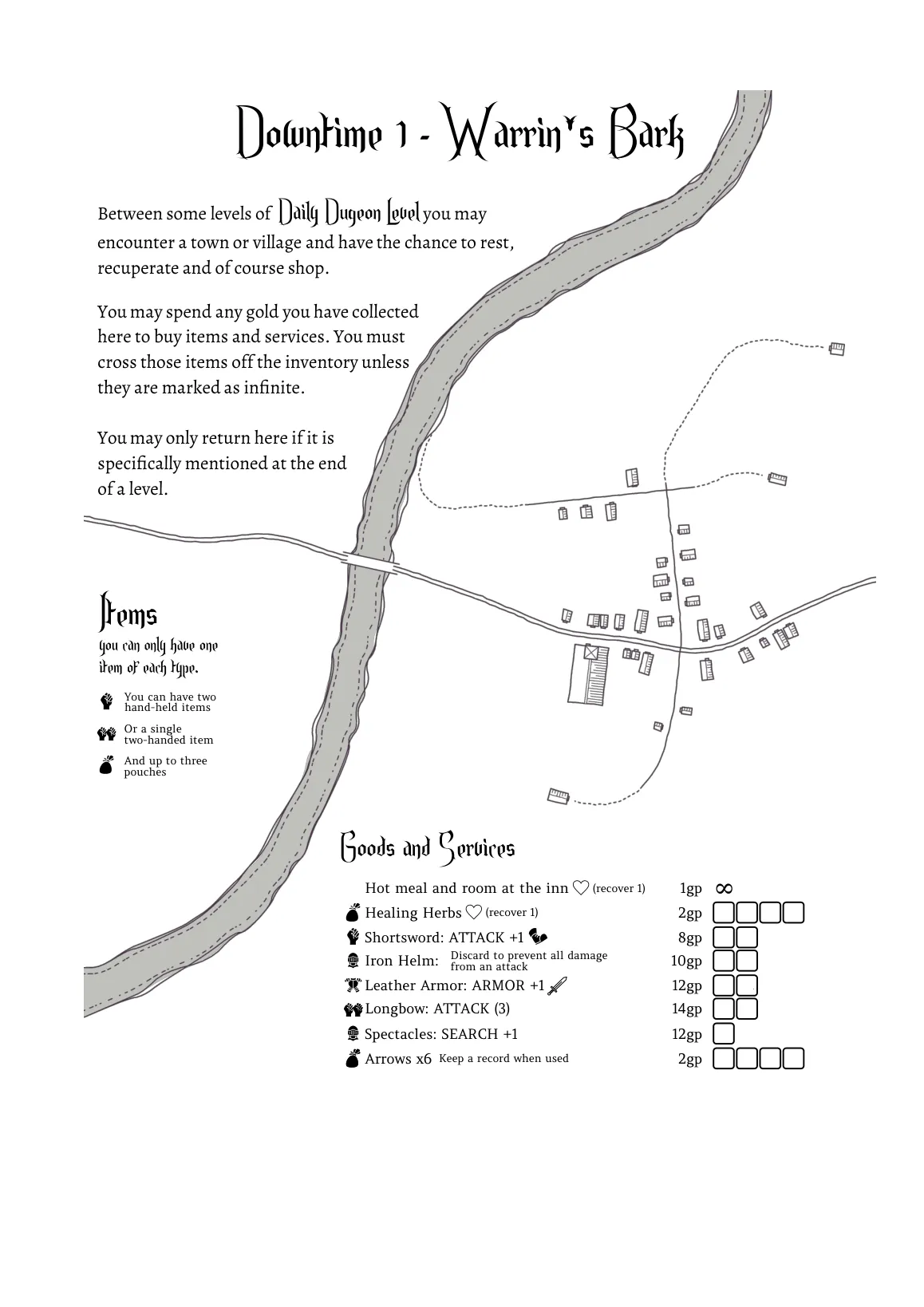
Between levels, a village. Stock is finite, so the boxes get crossed off and the shop is poorer next time you pass through. 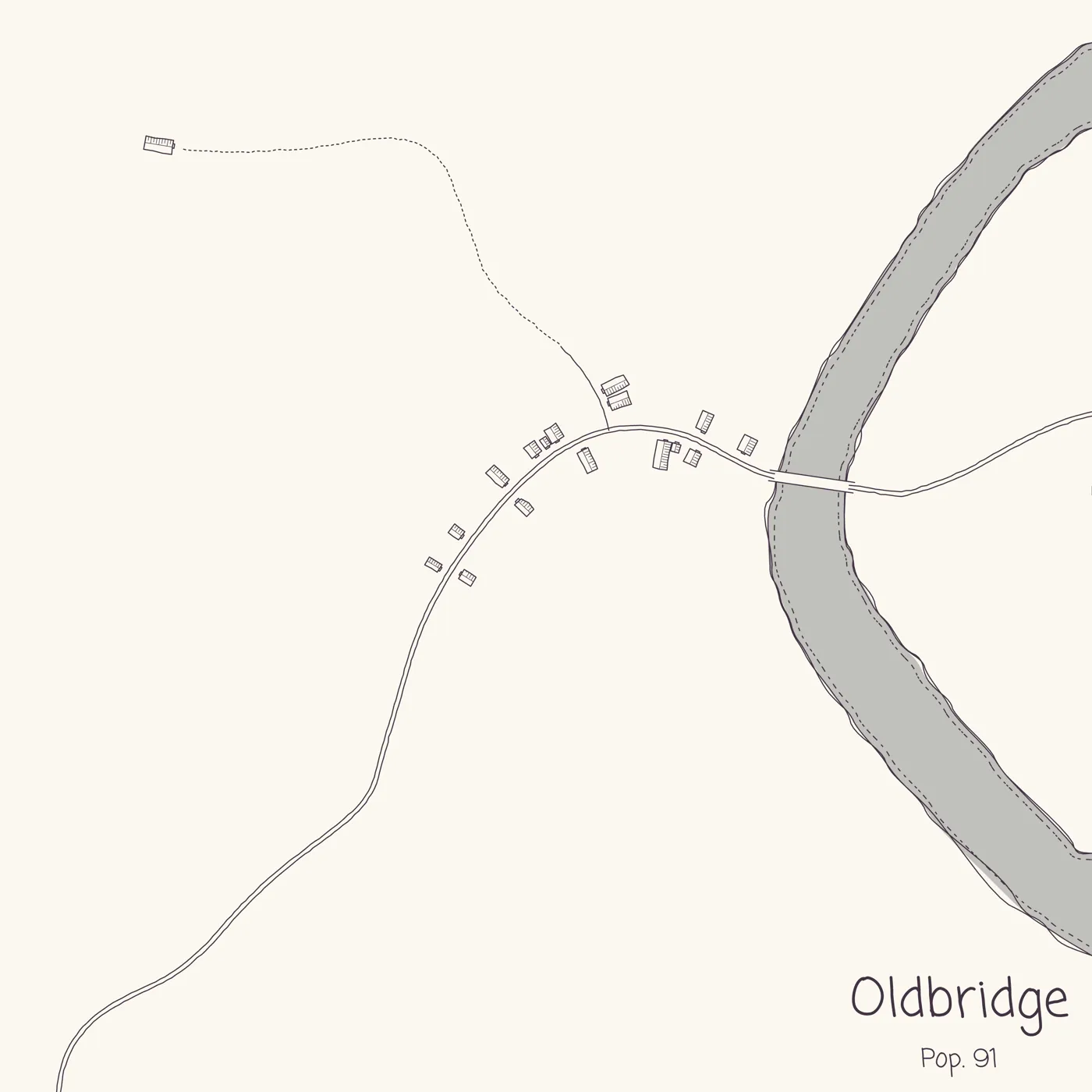
Oldbridge, pop. 91. Twelve of these were generated and named, ready for levels that never got written.