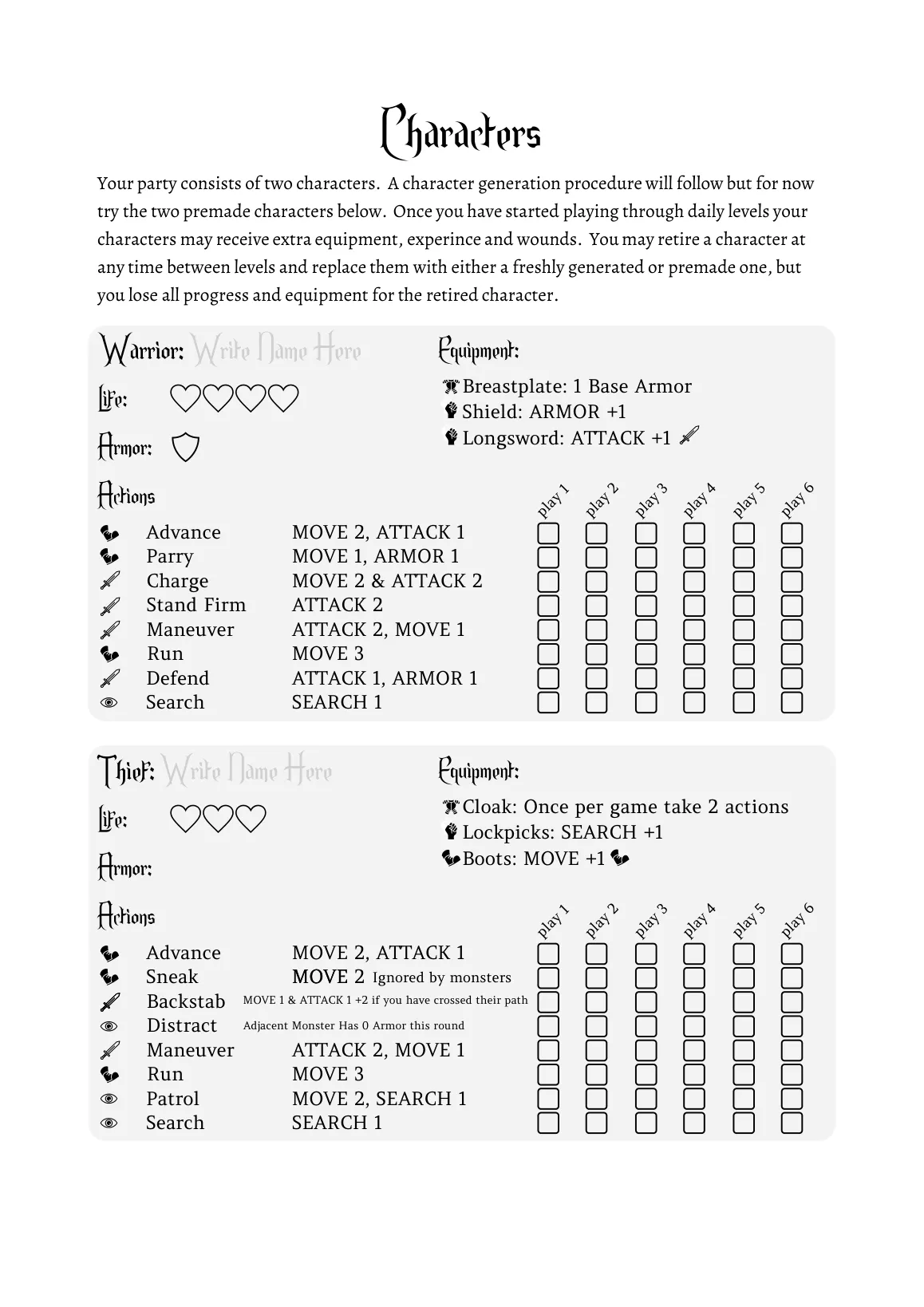
Daily Dungeon Level was going to be a dungeon crawl that arrived once a day on one side of paper. It got three levels in before I stopped, and the honest reason is unglamorous: it became too messy to keep track of on the paper.
Not too hard. Too fiddly. Every sheet carried three monster action grids, life counts to mark off, armour to subtract, search boxes to tick, gold, experience, equipment, and a character sheet where checked boxes meant three different things depending on why you’d checked them. All of it individually fine. Added together, more admin than the fifteen minutes I’d promised, and getting worse with each level rather than better — level two needed marginal notes for a gate, a secret door, standing in water and a summoning rule, and level three would have needed more.
What I obviously needed was a simpler system. What took me longer to see is why I couldn’t get one.
The thing I hadn’t noticed
I’d been looking at the dailies — Wordle, crosswords, sudoku — as examples of elegant, minimal rules. Wordle is about three sentences long. Sudoku is one: fill the grid so no digit repeats in a row, column or box. Astonishing economy. Just be that economical, I thought, and there’s your daily.
But those rules aren’t the whole system. They’re the small part of the system that has to be written down, because the rest of it is already installed in the player.
Wordle is not three sentences. Wordle is three sentences plus English — the spelling, the word frequencies, the sense that ARISE is a reasonable opener and XYLYL is not, the feel for where a Q goes. The game is entirely constructed out of that knowledge. Its rules do nothing but define a scoring notation over the top of a dictionary that every player brought with them, for free, and spent twenty years acquiring.
Sudoku is the same trick with digits. The rules never explain that there are nine of them, that they’re distinguishable, that “no repeats” is a meaningful constraint. Crosswords lean even harder: the grid, the numbering, the conventions of cryptic clueing, the shared reflex that “flower” might mean a river. Enormous shared apparatus, none of it printed, all of it assumed.
That’s the leverage. Those puzzles get to be tiny because they’re the visible tip of something huge that costs the designer nothing to include.
A dungeon has no dictionary
Now try it with a dungeon.
There is no shared convention that tells a player what a wight does, how far it reaches, whether a door blocks line of sight, what armour subtracts from, whether you can move diagonally, or what happens when you stand in water. None of that is installed. So all of it has to go on the page — and every monster, item, door and hazard I added was a rule I had to print, in the margin, on every sheet that used it.
Which is exactly the shape of the failure. My rules weren’t bloated because I was a sloppy designer. They were bloated because they had no substrate to sit on. The three-by-three monster grids I was so pleased with are a good mechanism, and they’re also a confession: I had to draw a lookup table for every monster type on every level, because there is no cultural agreement about how a giant spider behaves that I could just point at.
And the daily format makes it worse in both directions at once. A daily has to be playable by someone who’s never seen it, today — so it must re-teach itself constantly. But mine also carried a campaign: wounds, gold, experience, equipment, permanent marks on a character sheet. A returning player needs yesterday’s paper; a new player needs the whole rulebook. Wordle carries no state at all, which is why it can be handed to a stranger in a tweet.
Why I didn’t just borrow one
There is an obvious escape route. If the leverage comes from a convention the player already has, use a convention.
The trouble is which ones are actually available. The conventions with that kind of universal reach are basically language and number — spelling, vocabulary, arithmetic, the ordering of digits. Which means the escape route leads directly to making a word game or a maths game with dungeon art stuck on it.
I didn’t want to make a word game or a maths game. I wanted the dungeon to be the thing you were thinking about — position, threat, whether to take the wound or the damage. The moment the puzzle’s real content is “anagram this” or “these sum to twelve”, the dungeon has become a skin, and I’d rather just make the boardgame.
So it’s a genuine constraint, not a failure of nerve. The daily puzzle format has a very small number of load-bearing pillars available to it, and none of them hold up a dungeon.
What I’d take from it
Three things, and I think all three are portable.
Ask what the player is bringing before designing what you’re giving them. Rules on the page are a cost. Knowledge in the player’s head is free. The ratio between those two decides whether a thing can be a daily at all, and it’s worth knowing the answer before you draw eleven pages of monster grids.
Simplicity isn’t a property of a rulebook. It’s a property of the rulebook plus its audience. Every “look how elegant this is” example I was learning from was quietly enormous, and I was measuring the wrong half.
A daily and a campaign want opposite things. State is what made my characters interesting — a sheet that gets narrower as it ages is a genuinely good idea and I’d use it again. It’s also completely incompatible with a puzzle that has to be droppable and re-joinable by anyone on any given morning. I was trying to be two products.
The last one is the reason none of this was wasted. The mechanisms were fine; the container was wrong. Daily Dungeon Level was a boardgame that I’d decided, in advance and for no good reason, had to arrive one page at a time.