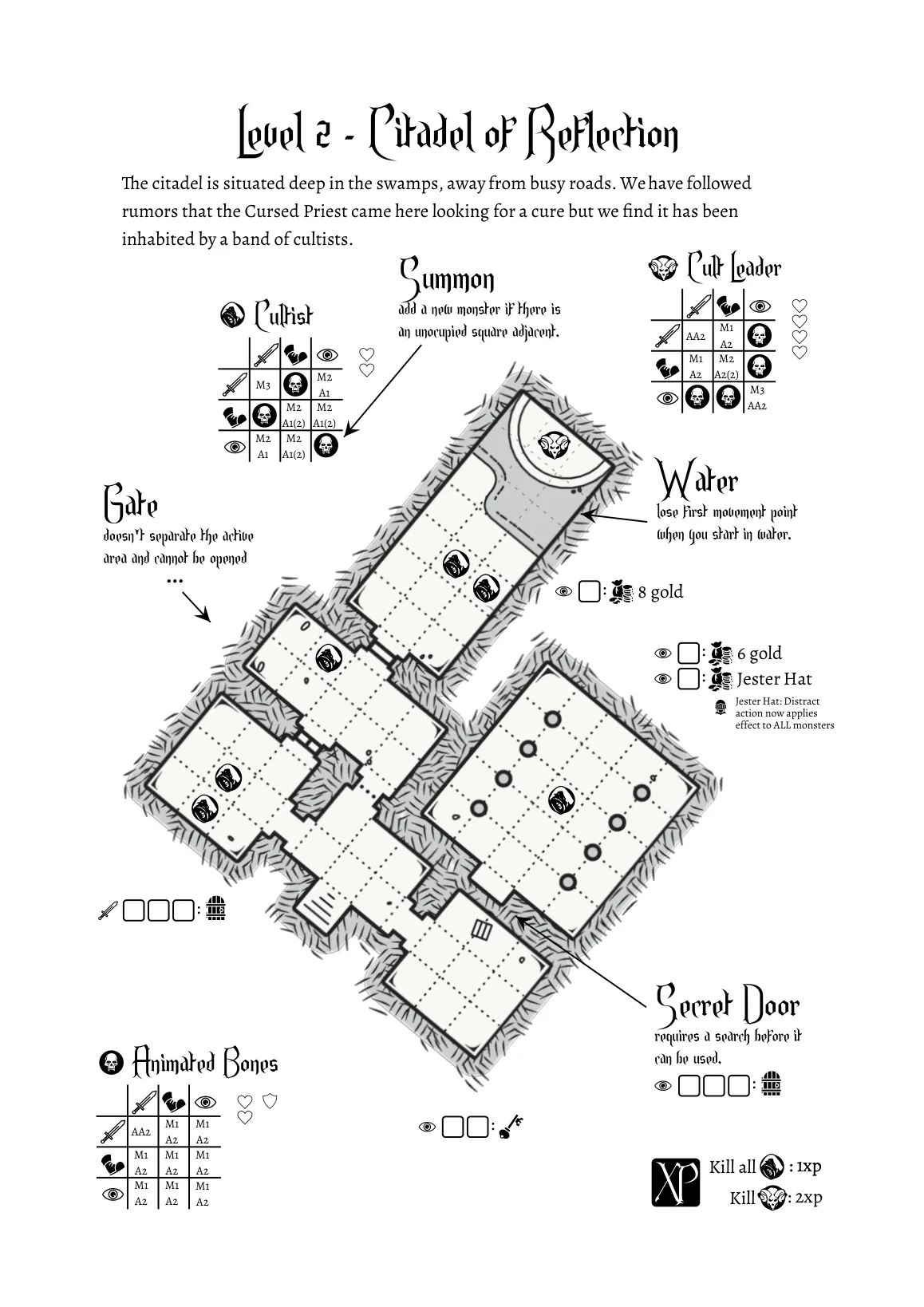
In 2020 everybody was making something at the kitchen table, and what I wanted to make was a dungeon you could get through in fifteen minutes and then throw away.
The appeal of the daily puzzle had very little to do with puzzles. It was the shape of the thing. One arrives, you do it, it’s the same one everybody else got that day, and then it’s finished and you’re not still doing it at midnight. Games I love mostly can’t do that. A dungeon crawl means a box, a table, an evening, and usually three other people who are all free on Thursday.
So: Daily Dungeon Level. One sheet of A4 per day. The level on one side, everything you need to read it on the other. Print it, play it with a pen, keep the sheet.
The rule I set myself
No dice, no app, no dungeon master, nothing to punch out or set up. If the sheet and a pen aren’t enough, it doesn’t go in.
That knocks out most of how solo dungeon games normally work. Something has to decide what the monsters do each turn, and the usual answer is a table you roll on — which is fine at a table with a bowl of dice on it, and miserable when you’re trying to do a thing on the bus in fifteen minutes. It also makes the game something that happens to you.
The answer I landed on is the bit I’d keep. Every character action is one of three kinds: a boot, a sword, or an eye. Each monster type carries a small three-by-three grid. You pick an action for each of your two characters, you carry them out, and then you look up the two action kinds on the grid — and that tells you exactly what every monster of that type does back.
Nothing random, nothing hidden. The monsters are a function of your own two choices. Sneak past the wight with two eye actions and you have chosen what the wight does about it, you just have to read the grid to find out what you chose. A level is fully solvable in advance if you’re willing to sit and stare at it, which is precisely what I wanted a daily to be.
The sheet is the save file
The other half was making a campaign fit in the margin.
Each character has eight actions and six columns of checkboxes, headed play 1 to play 6. A play is a hand: within one you can’t repeat an action, so you spend down through them, and to start a fresh play you must permanently retire one action and take up something else.
Then everything else reuses that same checkbox. Take a hit you can’t survive and you may accept a wound instead of the damage — check a box, and that action is gone from that play forever, in every future game with that character. Get knocked to zero and you retreat, wounded. Spend experience to raise a number in one of your actions, and you check a box for that too: with experience comes age.
I still like that a lot. One mark on the paper means growth, injury and getting old, depending on why you made it. Characters improve and narrow at the same time, and eventually you retire them and roll someone new — and all of it is a pen and one page, no bookkeeping app anywhere.
Dungeons, and the places between them
The floorplans began as output from Watabou’s One Page Dungeon generator, then got worked over by hand: rooms reshaped, monsters and gold placed, doors decided, secret doors hidden behind a search. The villages you pass through between runs came from the same author’s Village Generator. I generated twelve, named them all, and gave one of them a shop — Warrin’s Bark, where there are exactly two shortswords and when they’re gone they’re gone.
Both generators are lovely, and honestly they’re why the format seemed viable. They draw the way a dungeon should look on a photocopied page, and I could get a level to look finished in an evening.
Three levels in
It got to three levels, a village, a rules sheet and two premade characters — the House of the Cursed Priest, and the Citadel of Reflection twice — across a couple of weeks in May and June 2020. Then it stopped.
Not because it wasn’t fun. Because each new sheet needed more explaining than the one before, and I could see where that curve was heading. The reason turned out to be a genuinely interesting thing about daily puzzles that I hadn’t understood before I tried to make one, so I’ve written that up on its own: what Wordle is actually leaning on.