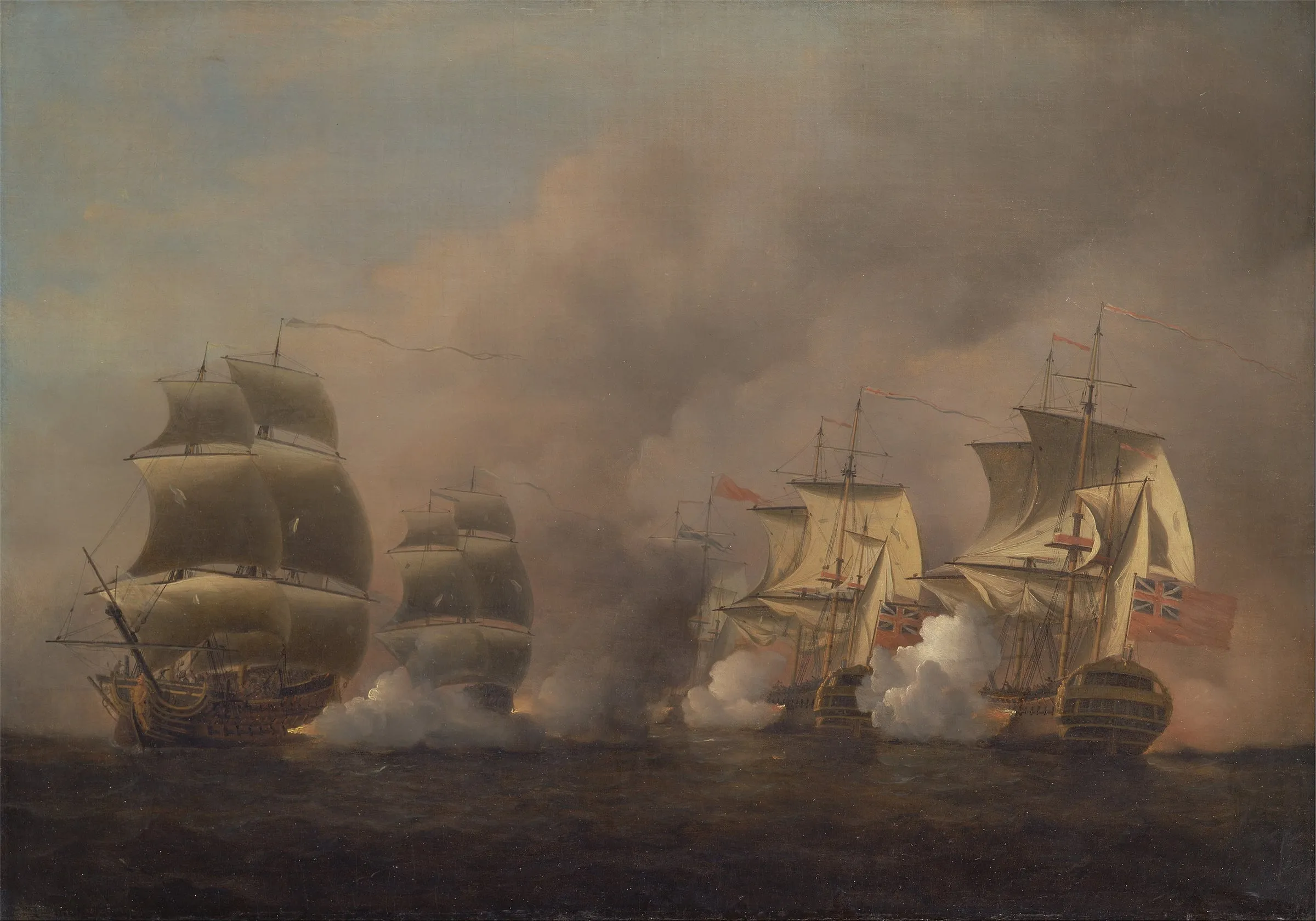
Samuel Scott, Action off the Cape of Good Hope, c.1757. Public domain, via Wikimedia Commons.

I’ve started a new game. It’s called Bow Chasers, and it’s about Age-of-Sail naval battles between small squadrons of three to eight ships.
A lot of the blame for this goes to Black Sails. If you haven’t seen it, it’s a pirate show that ran for four seasons and somehow never got the audience it deserved, which is a shame, because it’s brilliant. What pulled me in was the characters, how they play off each other and change over a story that takes all four seasons to tell. But the ships are great too: the chase, the slow turn to bring the guns round, and then the broadside. I wanted a game that feels like that.
I haven’t built anything yet. This is what I think the game is before I’ve played it, so I can come back later and see how wrong I was.
Starting digital, designing for the table
What I actually set out to make was an online game. Something async, where you put your orders in whenever you’ve got ten minutes and the turn plays out once everyone has. My first notes were all about that: servers, turns, what the screen would show.
The trouble with designing a computer game on paper is that the computer can do anything. It can track a ship’s momentum to three decimal places, work out exactly how much the wind is helping, and keep a dozen hidden numbers on every mast. None of that costs anything to add, so it creeps in, and before long you have a game that only the computer understands.
So I started asking a different question: how would this work on a table? Little ships, plastic templates, dice, X-Wing style. If I could make it work there, with nothing but things you can pick up and look at, then it would be easy to follow on a screen too. And honestly, I’d quite like to play it that way as well.
That question has shaped nearly everything below. Everything about a ship has to fit on one helm card, because that’s what you’d have in front of you. Distances and angles have to come from templates and a wind wheel, not measurements. If a rule needs arithmetic, it probably shouldn’t be there. Dice and counting only.
It also turned out to suit online play really well. At the table, everyone writes their orders down at the start of the turn so nobody can change their mind halfway through. That’s exactly what an async game needs: one submission per player, then the turn plays out. So the rules are now written for the table, and the digital version has to follow them rather than do its own thing.
I still want it to feel like sailing. Wind should matter, turning should matter, crossing someone’s stern and raking them should feel great. It just has to get there without assuming you know how to sail a frigate.
Orders
Each ship gets three orders a turn: a sail order (raise, lower, hold), a movement order (straight on, turn, tack, wear, heave to) and a combat order (fire a broadside, hold fire, prepare to board). At the table they’re cards placed face down. Online it’s a menu. Everyone reveals together, and nobody has to make a decision in the middle of the turn.
Sail and wind
Each ship has a sail token: Reefed, Battle or Full. It can only move one step a turn, so you can’t go from crawling to flat out in one go. That’s all the momentum I want. Full sail is fastest but turns worse, reefed is slow but nimble, and Battle sits in the middle.
Big ships can be just as fast as small ones in a straight line, but they turn like a barn door. The frigate gets to be the nimble one.
Wind is read with a Wind Wheel: a disc you drop over a ship and line up with the wind marker. The wedge under the bow tells you whether you’re running, on a reach, close hauled or stuck in irons. No random wind changes. The scenario says when it shifts, and you get a turn’s warning. Before deployment both sides secretly bid points for the weather gage, so wanting the wind costs you ships.
Movement
One template per ship per turn, covering distance and turn together. Four lengths, straight or curved, and the curved ones are shorter, so turning costs you ground. One decision, one bit of plastic on the table.
Combat is a handful of dice
This is the bit I’m most looking forward to. A broadside is a big pile of dice, 6 for a small ship up to 18 for the biggest. Range decides the colour: red up close hits hard, blue at long range mostly misses. Rake an enemy through the bow or stern and the dice go up a colour, which is the whole reason to try and cross their T.
You don’t aim at anything. You roll and count the hits. Each side of the ship reloads separately, so you can’t fire the same broadside two turns running, and a lot of the game should be about turning to bring the loaded side to bear. The bow and stern chasers are there for when nothing else bears, which is usually when you’re chasing someone down or running away.
There’s no shooting phase. Ships move one at a time, and anyone can interrupt a move to fire. Sail across an enemy’s broadside and you’ll get shot at, and you shoot back if your guns bear. Both sides roll before any damage lands.
At the table you choose when to interrupt, so you can wait for a closer shot. Online, the server fires as soon as something is in arc, which usually means long range. That’s the one place the two versions don’t match yet, and I haven’t decided how to fix it.
Damage
My first go at rigging damage was a track with thresholds, and it was horrible, so it’s gone. Hull and crew are just numbers. Lose half your hull and you lose some guns. Lose half your crew and you reload slower. Hit zero and you sink or strike.
Rigging hits are a draw from a bag of counters: mostly blanks, some lost sail, some lost rigging, one lost mast. The counter goes back in afterwards. Big ships shrug off the first hit or two from each broadside. A ship can never get worse than the shortest template and the gentlest turn, so however battered you are, you’re still playing.
Boarding
Get two ships touching with one of them ready to board and you get a tug-of-war along a little track. Both crews roll, kills take crew off, captures pull the marker your way. Three rounds a turn, so it plays out over a few turns rather than one roll. Pirates hit harder but defend badly, and soldiers are good at holding on.
Points
You buy your squadron from a points budget, and the same points are the score. Sink or capture a ship and you get its full cost, leave it struck and drifting and you get half. Points you spent bidding for the wind don’t score anything.
What’s not in it
No formation or signal rules. If you want to sail in a line, sail in a line. No fog of war for now, and no fires or repairs.
The online version
The rules will live in their own package with no framework in it, and everything else uses that. A boardgame.io server handles the turns, Postgres keeps the games and the history, and a Three.js client draws it. Dice use boardgame.io’s seeded random, so the same orders always give the same result, and the “play turn” button just replays what the server already worked out.
I’ll do a plain 2D top-down view first. That’s enough to playtest with, and the 3D can wait until I know the game is actually fun.
What I need to find out
All of this is guesswork until it’s been played. Things I’m worried about:
- Does everyone just sit on full sail all game?
- Do frigates actually feel faster than ships of the line?
- Is raking too good?
- Is the damage bag too harsh, or not harsh enough?
- Does boarding stall, or snowball?
- Do tacking and wearing feel right on a real table?
- What to do about interrupt timing online.
Most of the numbers are first guesses and I expect to change nearly all of them.
Next
First the rules package: templates, the wind wheel and the geometry, tested against measurements from real templates. Then combat, damage and boarding, then the turn itself. I’ll write up how it goes.